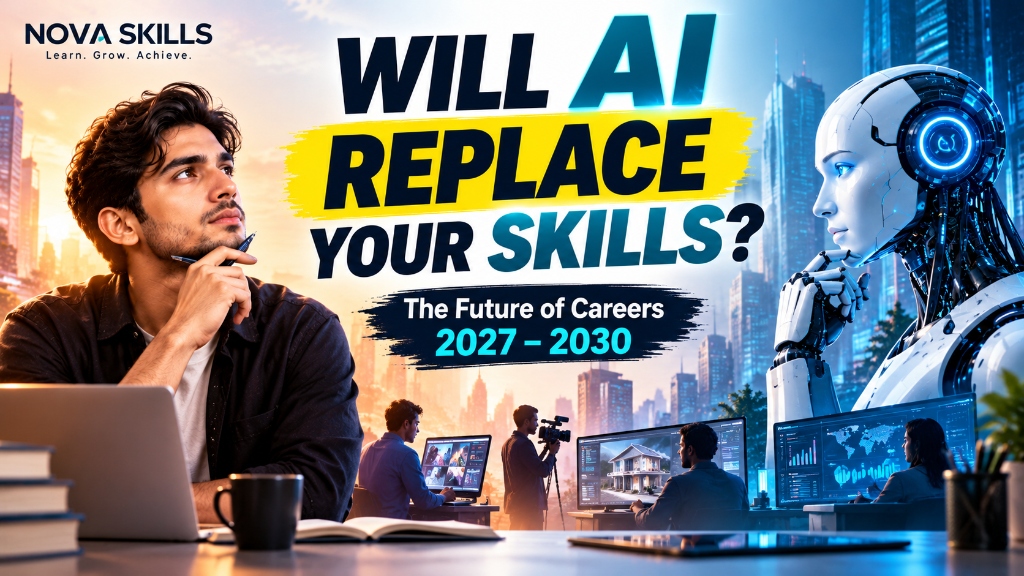
Central question: If AI can draft a message, design an advertisement, write a script, analyse a spreadsheet and operate software, what remains valuable about human skills?
Short answer: The value is shifting from simply producing routine outputs to defining important problems, exercising judgment, coordinating systems, verifying results, understanding customers and accepting responsibility for outcomes. AI literacy matters; so do deep domain competence, communication, ethics and the ability to demonstrate completed work.
Evidence disclaimer: This article is a synthesis of published reports, not an original field survey or a forecast with guaranteed outcomes. Global statistics describe the populations and methods used in their respective studies; they should not be interpreted as promises about an individual’s career, salary or employment in India.
Quick Answers: The Future of Skills in the AI Era
Will AI replace jobs by 2030? Some tasks will be automated, and roles will change, but task exposure is not the same as an occupation disappearing. The scale and direction of job change depend on adoption, industry, regulation and demand. ILO, 2025.
Which skills should students prioritise? Combine domain expertise with AI literacy, critical thinking, communication, data analysis, responsible automation and a portfolio of completed work. There is no universally guaranteed “future-proof” job. WEF, 2025.
Is agentic AI different from a chatbot? A chatbot primarily exchanges messages; an AI agent can use tools and perform authorised actions toward a goal. Reliable agents still need boundaries, tests, logging and human review.
What changes for digital marketing? Routine content creation becomes easier; campaign strategy, customer insight, measurement, creative judgment and business outcomes remain critical. SEO fundamentals also support AI search visibility; no special AI-only markup is required for Google AI features. Google Search Central, 2026.
What should a beginner do in the next 90 days? Select one target role, learn essential concepts, complete one realistic project, document the process and outcomes, and ask for feedback before adding more tools.
Research scope: A narrative synthesis of published global reports and practical examples, not a new field study, systematic review, placement guarantee or India-specific jobs forecast. See Research Method and Limitations and Sources.
Abstract
Artificial intelligence has changed the economics of several knowledge-work tasks. An increasing number of systems can draft, summarise, translate, classify, code, generate creative assets and perform multi-step computer actions. This has understandably intensified the question of whether familiar technical and professional skills will remain valuable between 2027 and 2030. The answer requires a distinction between task automation, occupation redesign, employment outcomes and career preparedness.
The International Labour Organization estimated in 2025 that roughly one in four workers worldwide held an occupation with some exposure to generative AI, but exposure is not equivalent to replacement. The World Economic Forum estimated that 39% of existing skill sets could be transformed or outdated between 2025 and 2030. Stanford's 2026 AI Index documents rapid AI adoption, yet also records meaningful gaps between benchmark performance and dependable autonomous business execution. These findings support neither complacency nor the claim that every occupation will disappear. They support a practical argument: professionals must combine domain knowledge, AI systems literacy, measurable delivery and human oversight. ILO, 2025; WEF, 2025; Stanford HAI, 2026.
This paper-style guide examines what AI agents actually do, where they remain unreliable, how digital marketing and automation roles are changing, which capabilities retain value, and how learners can build evidence of competence through practical projects. It concludes with a conditional 2027–2030 outlook and a 90-day portfolio roadmap.
Keywords: future of work 2030; AI skills 2027; agentic AI; AI agents; AI automation; digital marketing careers; marketing analytics; workflow automation; upskilling; human-AI collaboration; career roadmap India.
1. Introduction: The End of “Knowing a Tool” as a Complete Career Strategy
For years, a learner could differentiate themselves by learning a software interface that most other people could not operate. Someone who understood video editing, website builders, spreadsheets or advertising dashboards could perform work others had to outsource. That advantage has not vanished, but it is changing. When an AI assistant can generate a first draft in seconds, the scarce resource is often no longer the draft. It is knowing whether the draft is correct, useful, legal, on-brand and effective.
Consider a local education institute trying to attract applicants. Generating ten social-media captions is relatively easy. Defining an honest offer, identifying qualified prospective students, designing a trustworthy landing page, tracking enquiries, responding respectfully to prospects, protecting personal data and measuring actual admissions is not. These activities depend on a coordinated process, not a single AI prompt.
The key distinction is between creating an output and owning an outcome. Output is a poster, blog post, code snippet or spreadsheet. Outcome is a measurable improvement such as fewer manual errors, faster verified turnaround, better qualified enquiries or clearer customer decisions. AI can contribute to both, but responsibility for the result remains with people and organisations.
The purpose of this article is not to suggest that everyone should become an AI engineer. It is to show how different learners—creative professionals, marketers, business owners and non-coders—can combine AI with a discipline in which they build genuine competence.
2. What Does the Evidence Actually Say?
2.1 Exposure is not the same as elimination
The ILO's 2025 refined global index used task-level analysis, expert input and AI model assessments to estimate occupational exposure. About one in four workers were in occupations with some generative-AI exposure; around 3.3% of global employment was in the highest exposure category. Clerical work was particularly exposed. This classification measures potential task-level effects, not a deterministic count of lost jobs. Source: ILO Working Paper 140, 20 May 2025.
A customer-service representative illustrates the distinction. AI may classify enquiries, retrieve approved information and draft replies. The human may still handle exceptions, dissatisfaction, negotiation, risk and accountability. The occupation may change substantially even when a human role persists.
2.2 Skill requirements are moving faster than course brochures
The World Economic Forum's Future of Jobs Report 2025, drawing on employer surveys, estimated that 39% of workers' existing skills would change or become outdated during 2025–2030. It identified AI and big data, technological literacy and cybersecurity among fast-growing technical areas, while also emphasising analytical thinking, creative thinking, resilience, leadership and lifelong learning. Source: WEF Future of Jobs Report 2025.
The educational implication is straightforward: a course built only around a fixed list of buttons and menus risks ageing quickly. Teaching should include concepts that survive interface changes: information architecture, statistics, research methods, customer psychology, security, testing and decision-making.
2.3 Adoption is growing, but competent autonomous agents remain an early-stage practice
Stanford HAI's AI Index Report 2026 records AI adoption by 88% of surveyed organisations in 2025, while agent deployment remained in the single digits across nearly all business functions. This is an important distinction between adopting some AI capability and operating mature, reliable autonomous systems at scale. Source: Stanford HAI, Economy chapter, 2026.
The same report describes AI agents reaching 66.3% success on OSWorld, a structured benchmark involving computer tasks. That is major technical progress, but it also means the leading system was unsuccessful in approximately one-third of those benchmark attempts. A benchmark score is not a direct measure of failure rates in every real organisation, yet it demonstrates why logging, approvals and exception handling remain essential. Source: Stanford HAI, Technical Performance chapter, 2026.
2.4 The AI wage premium is not a salary guarantee
PwC's 2025 Global AI Jobs Barometer found an average 56% wage premium for job postings associated with AI skills compared with comparable postings without those skills, using its specified data and methodology. This is a population-level observational finding. It does not mean that completing a course will increase an individual's salary by 56%, nor that the premium applies equally to every country, industry or experience level. Source: PwC, 3 June 2025.
2.5 Research evidence at a glance
| Evidence | Reported finding | What it means for a learner | What it does not prove |
|---|---|---|---|
| ILO, 2025 | Around 25% of workers have some GenAI occupational exposure | Learn to redesign tasks and handle exceptions | One quarter of jobs will vanish |
| WEF, 2025 | About 39% of existing skills may change by 2030 | Update skills continuously and build adaptability | Every profession requires the same technical stack |
| Stanford AI Index, 2026 | 88% of surveyed organisations use AI; agent deployment remains limited | AI literacy is widespread; agent operations need care | Every business runs mature autonomous agents |
| Stanford AI Index, 2026 | Leading OSWorld agent scored 66.3% | Test, monitor and approve consequential actions | Agents can safely execute all tasks without supervision |
| PwC, 2025 | 56% average AI-skills wage premium in analysed job postings | AI capabilities can have labour-market value | Any course guarantees a 56% raise |
Methodological note: These studies vary in geography, sample, unit of analysis and year. Their estimates should not be combined into a single prediction or presented as a causal proof of individual career outcomes.
3. The Four Economic Layers of AI-Era Work
A useful framework is to divide work into four layers. This is an editorial model for planning, not a classification published by the above institutions.
Layer 1 — Routine production: Drafting a first caption, converting file formats, extracting standard invoice fields, rewriting boilerplate text, creating a basic report or generating common code structures. These are natural candidates for faster AI-assisted execution because they are repetitive and often easy to evaluate.
Layer 2 — Workflow coordination: Connecting a form, spreadsheet, CRM, inbox and reporting dashboard. This requires system design, permissions, data mapping, retries, exception handling and business rules. AI can help with construction, but a human still needs to understand the end-to-end process.
Layer 3 — Domain judgment: Deciding which customer segment matters, whether a source is reliable, which metrics indicate genuine value, and how technical or creative output should reflect the real-world context. This depends on experience, careful investigation and evidence.
Layer 4 — Responsibility and trust: Approving significant spending, respecting privacy and intellectual property, handling adverse outcomes, communicating with stakeholders and ensuring decisions can be defended. Even highly capable systems do not eliminate the organisation's accountability.
The practical strategy is not to abandon Layer 1. Learners still need to understand how work is performed. Rather, they should learn to move confidently from Layer 1 into Layers 2–4.
4. AI Agents and Agentic AI: Beyond a Chatbot
4.1 Definitions without hype
A generative AI assistant accepts information and returns generated content or analysis. An AI agent is an application that can select or perform actions through tools, often using model reasoning, data and a defined workflow. An agentic workflow may include several steps, persistent state, tool calls and conditional decisions.
The dividing line is not absolute: many modern assistants use tools, and many workflow automations are mostly deterministic. A good engineering design chooses the simplest reliable structure that solves the problem.
4.2 An example: a business enquiry assistant
Imagine a prospective learner submitting a course enquiry. A safe agent-assisted process might be:
- Receive an enquiry through an approved form and validate required fields.
- Check consent and store only information needed for the stated purpose.
- Identify the course and retrieve its approved fee, duration and syllabus.
- Classify the enquiry using transparent, testable rules.
- Draft an acknowledgement using only approved factual content.
- Request staff approval before sending anything sensitive or consequential.
- Update lead status in a CRM and schedule an authorised follow-up.
- Log the action outcome, errors and any human intervention.
- Summarise aggregate performance without sending personal identifiers to analytics tools that should not receive them.
Notice that the valuable skill is not simply writing the prompt that produces a reply. It is designing a dependable, measurable, privacy-aware process.
4.3 Practical agent architecture
A learner should understand six components: input, instructions and policy, knowledge retrieval, tools/actions, state and memory, and observability/human approval. A system may use Python and APIs, or an automation platform such as n8n or Make, depending on complexity. The choice of tool is secondary to correctness, cost and maintainability.
Failure modes to practise: hallucinated policy details; outdated course fees; duplicate follow-ups; unauthorised messages; prompt injection in customer-submitted text; missing API permissions; silent integration errors; incorrect time zones; and excessive data retention.
Minimum safeguards: approved knowledge sources, least-privilege access, human review for sensitive actions, explicit budget limits, idempotent lead creation, audit logs, clear failure alerts, and a tested manual fallback.
4.4 What makes this a real portfolio project?
A credible project is accompanied by a process map, sanitised sample data, a configuration or code repository, an evaluation checklist, a screen recording, and documented limits. A single screenshot of a chatbot conversation proves very little about reliability.
5. AI Automation: Moving from Repetitive Tasks to Reliable Business Systems
Automation connects events to outcomes. A rule such as “when a new approved lead arrives, add a record to the CRM” is deterministic. AI adds value where understanding language, classifying unstructured content or generating a recommendation is necessary.
Useful business examples:
- Lead operations: form submission → validation → CRM deduplication → assigned owner → human-approved reply → follow-up status.
- Document processing: receive invoice → extract candidate fields → compare with source → flag uncertainty → human approval → accounting entry.
- Support operations: classify incoming message → retrieve approved policy → propose response → escalate exceptions.
- Education operations: receive assignment → organise submissions → check format and plagiarism policy → produce teacher-facing summary; instructors retain academic judgment.
- Management reporting: consolidate performance from approved sources → detect missing fields → produce dashboard → attach caveats.
For non-coders, learning triggers, actions, filters, data mapping, webhooks and error handling is a practical entry point. For technically oriented learners, APIs, Python, SQL, authentication, testing and deployment provide greater flexibility. Neither group should skip privacy, security and quality checks.
A well-designed automation also knows when not to act. Uncertainty thresholds and escalation paths are features, not weaknesses.
6. Digital Marketing in the AI Era: Creativity Must Connect to Measurable Business Outcomes
Digital marketing is not disappearing because AI can generate banners or captions. But a marketer whose contribution is limited to producing variations of a generic creative will face stronger competition from automated tools.
Consider the complete marketing chain:
Research → Audience hypothesis → Offer → Creative → Landing experience → Traffic → Enquiry → Qualification → Follow-up → Sale/admission → Reporting → Iteration
AI can assist at every stage, yet it does not automatically know whether a lead is qualified, whether a promise is compliant, whether campaign data is correctly attributed or whether the business can fulfil its offer.
6.1 Search and content
The fundamentals remain: clarify search intent, build useful pages, cite reliable information, maintain technical quality, and satisfy readers. Generative-search products may reshape discovery patterns, but claiming that “SEO is dead” obscures the continued role of accessible, accurate website content. The durable skill is understanding how information is discovered and evaluated—not chasing an unverified algorithm hack.
A note on AI search visibility: The same search fundamentals that help an article be crawled, understood and useful also matter for Google AI Overviews and AI Mode. Google's guidance does not require special “GEO files,” llms.txt, or AI-only schema. For publishers, practical priorities include first-party insight, accessible source-backed text, descriptive headings, crawlable internal links and accurate structured data. Google Search Central's AI optimization guide (2026). Microsoft also introduced an AI Performance preview in Bing Webmaster Tools in February 2026 to help publishers understand AI-answer citation patterns; this is a measurement tool, not a citation guarantee. Microsoft Bing Webmaster Blog (2026).
6.2 Paid media
AI can propose headlines and creative variations, assist with campaign analysis and accelerate reporting. The marketer is still responsible for selecting a meaningful objective, defining a realistic budget, testing offers, respecting platform policies, avoiding misleading claims and distinguishing cheap enquiries from valuable customers.
A campaign with 500 unqualified leads is not necessarily stronger than one with 80 qualified leads. The right measure depends on the business model and the cost of converting enquiries into revenue or admissions.
6.3 Analytics and CRM
An emerging digital-marketing generalist should be comfortable with GA4, Google Tag Manager, Google Search Console, Google Ads, Meta Ads Manager, spreadsheets and a CRM. Tools are examples, not a claim that all learners must master each platform equally.
Good analytics asks: Which acquisition sources generate valid leads? How many leads qualify? How quickly are enquiries followed up? Where do prospects drop out? Are conversion events duplicated? What data is missing or potentially misleading?
Illustrative metric:
Qualified lead rate = Qualified enquiries ÷ Valid enquiries × 100
If a hypothetical campaign generates 100 valid enquiries and 28 meet a pre-defined qualification rule, the qualified lead rate is 28%. This example is a teaching calculation, not a Nova Skills performance result.
6.4 Responsible AI-assisted creative work
Strong creative work still requires visual hierarchy, typography, cultural sensitivity, original thinking, honest claims and audience understanding. AI-generated visuals must be checked for factual errors, intellectual-property concerns and brand consistency. Designers who can art-direct, critique and iterate are more valuable than those who only collect prompt outputs.
7. The Role of Data Analytics: Turning Activity into Decisions
Data literacy is foundational because automated systems generate abundant activity and often produce persuasive-looking but misleading summaries. A useful analyst asks how the number was produced, whether it is complete and what decision the number should change.
Skills worth developing include:
- Spreadsheet cleaning, formulas and pivot tables.
- SQL concepts, joins, filters and aggregation.
- Data models and distinctions between dimensions and metrics.
- Descriptive statistics and interpretation of uncertainty.
- Dashboard design and metric definitions.
- Privacy-aware reporting, validation and data provenance.
- Clear written recommendations based on verified results.
Example: A dashboard claims that campaign enquiries increased by 40%. Before celebrating, an analyst checks whether duplicates, tracking changes, seasonality or changes in lead quality explain some of the rise. This is the difference between reporting a graph and investigating a business outcome.
A non-coding marketer may begin with GA4 and spreadsheets. A technical data analyst may add SQL, Python and business-intelligence tools. Both need the ability to challenge their own findings.
8. Which Human Skills Become More Important?
The WEF's 2025 skills outlook highlights analytical thinking, creativity, adaptability and continuous learning alongside technological expertise. UNESCO's AI Competency Framework for Students further emphasises human-centred thinking, ethics, technical understanding and system design. WEF Skills Outlook; UNESCO Framework.
- Problem framing. Before choosing AI, define the real problem, who experiences it, what success means and the constraints.
- Critical evaluation. Verify sources, recognise uncertainty, detect biased or fabricated outputs and compare alternatives.
- Domain expertise. Understand the market, industry, customer, student or operational environment in which the tool is used.
- Communication. Explain technical findings to a non-technical stakeholder and ask useful questions.
- Design and creative judgment. Choose what should be made, why it matters and how to improve it—not only how to generate variants.
- Systems thinking. See dependencies across people, data, tools, processes and incentives.
- Ethics, safety and security. Protect confidential data, seek consent, respect rights and establish accountability.
- Adaptability. Learn new interfaces without losing sight of transferable principles.
These are not substitutes for hard skills. They multiply the value of technical competence.
9. Career Pathways for 2027–2030: Four Practical Profiles
Forecasts should be interpreted cautiously. The following profiles are plausible learning paths, not guarantees that a particular job title will exist or pay a stated salary in 2030.
Path A — AI-Enabled Digital Marketer
Suitable for: Students interested in business, communication, content and customer acquisition.
Foundations: Customer research, copywriting, design basics, landing-page UX, SEO principles, paid-media fundamentals and analytics.
AI layer: Research assistance, creative concept development, controlled campaign reporting and customer journey analysis.
Portfolio evidence: Audience brief, complete campaign plan, annotated landing-page audit, tracking specification and dashboard demonstrating lead quality.
Possible entry-level functions: Marketing assistant, campaign coordinator, junior digital marketer or freelance marketing support—subject to demonstrated skills and employer requirements.
Path B — AI Automation Workflow Builder
Suitable for: Business-process enthusiasts, operations staff and non-coders willing to learn structured logic.
Foundations: Triggers, webhooks, spreadsheets, CRM records, JSON basics, authentication concepts and exception handling.
AI layer: Classification, grounded response drafting, document extraction and controlled tool actions.
Portfolio evidence: A documented enquiry workflow with error handling, audit trail and a human-approval checkpoint.
Possible functions: Workflow automation assistant, operations-automation coordinator or junior solutions implementer.
Path C — AI Application and Agent Developer
Suitable for: Learners willing to study programming and software architecture.
Foundations: Python, APIs, databases, Git, testing, authentication, security and deployment.
AI layer: Model APIs, retrieval-augmented generation, tool calling, stateful workflows, evaluation and observability.
Portfolio evidence: A business-document assistant that cites sources, handles missing evidence safely and records evaluation results.
Possible functions: Junior AI application developer, software engineer working on AI features, or automation developer. Entry requirements vary substantially.
Path D — Data and Marketing Analytics Specialist
Suitable for: Learners who enjoy investigation, metrics and decision support.
Foundations: Spreadsheets, SQL, statistics, data visualisation, data quality and interpretation.
AI layer: Assisted query drafting, data categorisation, summarisation and anomaly investigation—with human verification.
Portfolio evidence: A dashboard tying marketing spend to valid enquiries, qualification outcomes and documented data limitations.
Possible functions: Junior data analyst, marketing analyst or reporting specialist.
Important distinction: A pathway is not the same as a full course syllabus. Some pathways can begin with a short certificate; others require sustained study and substantial practice.
Choose a Practical Learning Path
Rather than taking every trending course, select a pathway using your starting skills, interests and the portfolio evidence you can realistically build. The roles below are illustrative, not placement predictions.
| If you enjoy… | First learning focus | Proof-of-skill project | What to evaluate before enrolling |
|---|---|---|---|
| Creative communication and understanding customers | Digital marketing, audience research, SEO, paid-media fundamentals | Campaign plan with tracked enquiries and documented results | Whether the curriculum includes campaign measurement and practical feedback |
| Improving repetitive business processes | Workflow automation, data mapping, privacy and AI tools | Human-approved enquiry triage workflow with failure logs | Whether tools, limits, error handling and data safety are taught |
| Coding and building digital products | Python or JavaScript, APIs, databases and agent evaluation | Small AI assistant with test cases and clear permissions | Whether you will build, deploy and debug a working application |
| Finding patterns in numbers | Spreadsheets, SQL, analytics and data storytelling | Decision dashboard with clearly defined metrics | Whether data quality and interpretation are assessed |
Decision rule: Prefer a program whose published syllabus, teaching support, time commitment and assessment match your goals. A certificate alone is not evidence of job readiness. For available options, compare Nova Skills course syllabi before enquiring.
10. Three Portfolio Projects That Demonstrate Real Competence
Project 1 — Lead Enquiry and Follow-Up Workflow
Problem: Enquiries from a website or campaign are scattered across messages and spreadsheets.
Build: A test form, sample CRM, deduplication rule, assignment workflow, reply-drafting assistant and follow-up dashboard. Use fictional or consented data.
Assessment: Show that a duplicate submission does not create a second lead; an unapproved message is not sent; an invalid phone number is flagged; and failed API requests are logged.
Deliverables: Process diagram, 3-minute demonstration, configuration screenshots, annotated test cases and a one-page risk register.
Project 2 — Evidence-Grounded Business Knowledge Assistant
Problem: Staff spend time searching the same approved documents for fee, policy or procedure answers.
Build: A document-based assistant that retrieves relevant passages, cites them, asks for clarification when needed and refuses to invent absent facts.
Assessment: Test at least 20 representative questions, including ambiguous requests and deliberately missing answers. Record correct, incorrect and appropriately abstained responses.
Deliverables: Knowledge-source inventory, evaluation spreadsheet, controlled demo and a short explanation of limitations.
Project 3 — Marketing Performance and Qualified Lead Dashboard
Problem: Teams report clicks and enquiries but lack a consistent picture of qualified opportunities.
Build: A sample report combining campaign spend, valid leads, lead qualification, response time and conversion stages. Use a spreadsheet, GA4-style sample events or a BI tool.
Assessment: Define each metric, detect duplicates, highlight missing values and recommend one evidence-based action.
Deliverables: Dashboard, data dictionary, validation checks, executive summary and a practical next-step recommendation.
A portfolio is strongest when it shows the problem, the process, the test evidence, the trade-offs and the limitations—not only the final screen.
11. A 90-Day Roadmap for Beginners and Career Switchers
The following is an illustrative self-study sequence, not a guaranteed duration for job readiness. Adjust pace for previous experience, available time and chosen pathway.

| Period | Learning focus | Practical evidence |
|---|---|---|
| Days 1–15 | AI literacy, digital foundations, information quality, responsible use | A researched problem statement and source-checking exercise |
| Days 16–30 | Choose one primary domain: marketing, automation, coding or analytics | A small completed domain project with feedback |
| Days 31–45 | Learn workflows, data flow, tool limitations and testing | An end-to-end workflow diagram and functional prototype |
| Days 46–60 | Integrate AI carefully, add guardrails and error handling | A tested prototype with documented failure cases |
| Days 61–75 | Measure quality, usability and business relevance | Evaluation log, dashboard and revision history |
| Days 76–90 | Prepare an evidence-rich portfolio and seek critique | Case study, demonstration video and interview-ready explanation |
A weekly learning routine
Spend time in five modes: concept study, guided practice, independent construction, testing/review and reflection. A practical rhythm is to build something every week rather than postponing all practice until the end of a course.
Helpful self-assessment questions: Can I explain why a tool was chosen? Can I reproduce the result without copying a tutorial? Can I detect a fabricated answer? Do I know what data the workflow stores? Can I show what changed after feedback?
12. Five Common Career Mistakes in the AI Era
Mistake 1: Confusing prompt collection with professional skill. A good prompt helps; it does not replace data literacy, subject knowledge, testing or a client brief.
Mistake 2: Learning every trending tool without a project. Tool lists grow faster than any learner's available time. Choose a relevant stack and demonstrate one complete outcome.
Mistake 3: Trusting AI output without verification. Confident mistakes are still mistakes. Source checking and evaluation are essential when outputs affect money, careers, health, privacy or reputation.
Mistake 4: Treating course certificates as substitutes for proof. A certificate may show course completion. A portfolio demonstrates what a learner can actually build, evaluate and explain.
Mistake 5: Believing any career is guaranteed to be “AI-proof.” Labour markets depend on technology, economic conditions, regulation, geography, competition and organisational choices. A better goal is adaptability supported by genuine competence.
13. Scenarios for 2027–2030: What Might Change?
A serious discussion separates observable current trends from conditional future scenarios.
Scenario A — AI as a widespread professional copilot. Assistants become a normal part of writing, coding, media and administration. Workers who can verify and improve outputs gain productivity advantages. This follows existing adoption trends, but the benefits depend on training and workplace design.
Scenario B — More dependable task-specific agents. Organisations deploy agents for bounded, auditable workflows such as classification, internal lookup and status updates. Specialist builders, evaluators, security reviewers and business-process designers gain relevance. This depends on improvements in reliability, access control, cost and integration.
Scenario C — Entry-level task compression. Employers automate some repetitive junior tasks, potentially changing how beginners obtain practical experience. Education providers and employers respond by strengthening apprenticeships, simulation, project review and supervised delivery. The precise scale will vary by industry and cannot be read directly from benchmark progress.
Scenario D — Greater emphasis on verified trust. As generated content becomes cheap and abundant, source transparency, authentic expertise, privacy protection and independently checkable evidence become stronger signals of quality.
These scenarios can coexist. They are not four mutually exclusive predictions, and their timing is uncertain.
14. What Education Providers Should Change Now
Education providers should not merely add “AI” to every course title. They should distinguish beginner, professional and mastery programs by what students can demonstrably do after completion.
An evidence-oriented curriculum should describe module → lesson → practical exercise → project → assessment → feedback, with realistic time allocations. It should balance software skills with domain concepts and ethics. It should regularly revise projects when tools change and disclose what a course does not cover.
For a digital-marketing learner, an appropriate assessment might be a campaign brief and analytics interpretation. For an automation learner, it might be a tested workflow with fail-safe handling. For an agent developer, it might be a grounded assistant with an evaluation log. A sophisticated-looking output without testing should not automatically earn a mastery-level assessment.
Where practical, programmes should teach students to document assumptions, limitations, consent, and model-generated contributions. These habits matter as AI systems become more capable and more deeply integrated into work.
UNESCO's AI Competency Framework recommends progression through understanding, application and creation, while recognising human-centred and ethical responsibilities. UNESCO Framework.
15. India: Opportunities, Constraints and Realistic Career Planning
For Indian students and working professionals, AI-enabled work intersects with diverse realities: small businesses adopting digital systems, regional-language communication, growing online services, traditional industries modernising operations, and employers with very different levels of AI maturity.
That diversity creates useful learning opportunities. A local shop may need a simple inventory and enquiry system; a professional services firm may need document classification; an agency may need transparent marketing reports; a manufacturing team may need safer reporting workflows linked to approved enterprise systems. These are examples of potential business problems, not claims that every firm is currently buying such solutions.
Practical choices matter more than slogans. Ask whether a role requires a degree or licence, whether the employer values documented projects, what language skills are needed, whether data access is available and how much supervised experience is required. The reports cited above describe global patterns; local hiring conditions and actual vacancy listings remain necessary for individual decisions.
A strong India-focused portfolio can demonstrate the ability to work with local customer contexts, multilingual interfaces, affordability constraints and appropriate data handling. Technical competence should be paired with realistic expectations about employment, freelancing and client acquisition.
16. Limitations and Research Method
Method: This article compares publicly available institutional research from ILO (2025), WEF (2025), Stanford HAI (2026), PwC (2025), Microsoft (2025) and UNESCO (2024/updated 2026), then develops an editorial career-skills framework and illustrative projects. It is a narrative evidence synthesis rather than a systematic meta-analysis.
Limitations: Employer surveys capture expectations, not guaranteed outcomes. Job-posting studies may differ from realised wages or total employment. Task benchmarks are narrower than real business environments. Global figures may not represent India's regions or sectors. Product capabilities and interfaces change frequently. Scenarios for 2027–2030 are conditional, and individual outcomes depend on opportunity, practice, experience and constraints.
Editorial transparency: The article was developed as an AI-assisted editorial draft and underwent human source, claim and link verification before publication. It has not undergone formal peer review. The guiding topic was inspired by the Vintage Studio Productions article of 17 October 2026, Will Your Skills Still Be Valuable When AI Can Do the Easy Part? The full source page was not directly retrievable for line-by-line comparison when preparing this adaptation. Its confirmed themes informed the scope; claims and numerical findings in this publication are independently sourced below. This is not a verbatim reproduction of the original post.
17. Frequently Asked Questions
Will AI replace digital marketers by 2030?
AI is likely to automate or accelerate some marketing tasks, but the occupation's future depends on how businesses reorganise strategy, creative work, analytics, customer experience and accountability. It is more useful to prepare for changed responsibilities than to assume either total replacement or total safety.
Is learning prompt engineering enough for a career?
Usually not as a complete skill set. Prompting is useful within a larger capability: subject knowledge, evaluation, tool integration, data handling and communication.
Can someone without coding experience learn AI automation?
Yes, many bounded workflows can be developed with visual automation tools. A learner must still understand triggers, data structure, authentication, reliability and privacy. More complex applications may require programming.
What is the difference between an AI chatbot and an AI agent?
A chatbot primarily converses and generates responses. An agent can use tools and execute authorised steps toward a goal. The boundary is increasingly blurred; reliability and permissions matter more than the label.
Which is a better first career path: AI automation or digital marketing?
It depends on interests and aptitude. Business-oriented learners may prefer marketing and analytics; operations-minded learners may prefer automation; technical learners may choose application development. Each benefits from foundational AI literacy.
What does “future-proof skill” actually mean?
No skill offers a permanent guarantee. The more defensible goal is a transferable capability that can adapt to new tools: problem solving, analytical reasoning, communication, domain expertise, system design and responsible delivery.
Are AI agents reliable enough to run a business alone?
Reliability varies significantly. Benchmark progress is substantial, but independent deployment still needs permissions, monitoring, testing, escalation and human accountability.
Should students focus on certificates or projects?
Both can help, but they show different things. A certificate documents training or assessment; a project portfolio can demonstrate process, competence and verifiable deliverables. Check the legitimacy and scope of any credential claims.
Can AI improve earnings or employability?
Relevant AI skills may improve competitiveness, as some job-posting research indicates, but salary or placement results are not guaranteed. Individual outcomes depend on a broader set of factors.
How should a beginner start this week?
Choose one real problem, learn the related foundational concepts, build a small solution with safe sample data, test it, write down what failed, and seek feedback before scaling.
18. Conclusion: The Valuable Professional Is the One Who Can Be Trusted with Results
AI makes more outputs easier to produce. It also raises expectations. When anyone can draft a plausible report, a valuable professional must know whether the underlying data is correct. When an agent can act across applications, a valuable builder must know where approval, security and recovery belong. When a model can make a beautiful advertisement, a valuable marketer must know whether it respects the customer and advances a measurable business objective.
For learners considering 2027–2030, the strongest preparation is neither panic nor blind enthusiasm. It is the combination of real domain skills + AI literacy + accountable systems thinking + tested projects + continual learning.
The question is not simply, “Can AI do this task?” It is, “Can you identify the right problem, build a dependable solution, and explain why the result deserves trust?”
References and Further Reading
- International Labour Organization (2025). Generative AI and Jobs: A Refined Global Index of Occupational Exposure. Official ILO publication.
- World Economic Forum (2025). The Future of Jobs Report 2025. Official WEF report.
- Stanford Institute for Human-Centered AI (2026). The 2026 AI Index Report. Official Stanford HAI report; Economy chapter; Technical performance chapter.
- PwC (2025). 2025 Global AI Jobs Barometer. Press release & methodology overview.
- Microsoft (2025). 2025 Work Trend Index: The Frontier Firm Is Born. Official research announcement.
- UNESCO (2024; page updated 2026). AI Competency Framework for Students. Official publication.
- Vintage Studio Productions (17 October 2026). Will Your Skills Still Be Valuable When AI Can Do the Easy Part? Original thematic inspiration (full text not independently available at drafting time).
Additional official guidance for the AI-search discussion: Google Search Central, Optimizing your website for generative AI features (2026); Microsoft Bing Webmaster Blog, Introducing AI Performance in Bing Webmaster Tools Public Preview (2026). These sources support the discussion of publisher discoverability; they are not evidence that this blog will be cited or ranked by an AI system.
Editorial note: Illustrative workflows and career pathways are examples, not paid-placement promises, guaranteed salaries or claims that a specific Nova Skills course contains every tool listed in this article.
Build proof, not just familiarity.
Explore practical learning pathways and course details on Nova Skills. Select a course by its actual curriculum, duration, level, and project outcomes.
Explore Nova Skills Courses →